Relationship
between
Bagua and Xingyi Baguazhang ©
Bagua is the concept of ancient Chinese native materialism. It is an unique Chinese instrument used to explain and record the principles of relationship between movements, connections and evolutions of things about 3,000 years ago back to the Chou Dynasty (1122 – 249 B.C.) and Chin Dynasty (221 – 207 B.C.)
Ancient people used bagua to analyze and observe the galaxy movement, weather, the ecology of plants, and the habitatuality of birds and beasts having regard to its geographical conditions and to predict the changes of the universe and the health of mankind.
Moreover, ancient people used bagua an as oracle to predict future. They used “yin”, “yang”, and the five elements as the nuclear. “ ” and “ ” and “ “are used as the two fundamental symbols. “” represents yang (positive) and ““represents yin (negative). Three lines form into a group and there are eight main groups and then sub-divided into 64 groups. The 8 main groups are “ “are used as the two fundamental symbols. “” represents yang (positive) and ““represents yin (negative). Three lines form into a group and there are eight main groups and then sub-divided into 64 groups. The 8 main groups are “ ’’ symbolizes for heaven (NW); “ ’’ symbolizes for heaven (NW); “ ” symbolizes for water (N); “ ” symbolizes for water (N); “ ” symbolizes for mountain (NE); “ ” symbolizes for mountain (NE); “ ” symbolizes for thunder (E); “ ” symbolizes for thunder (E); “ ” symbolizes for wind (SE); “ ” symbolizes for wind (SE); “ ” symbolizes for fire (S); “ ” symbolizes for fire (S); “ ” symbolizes for earth (SW) and “ ” symbolizes for earth (SW) and “ ” for lake (W). From these groups and combine with the directions (4 uprights and 4 corners) and the five elements to form into “Bagua”. ” for lake (W). From these groups and combine with the directions (4 uprights and 4 corners) and the five elements to form into “Bagua”.
The four upright groups are Zhen, Li, Dui and Ken and the four corner groups are Xun, Kun, Chien, and Gen.
The four uprights groups and the four corners groups form the bagua sign and distributed evenly to form the Bagua non-Polarity Circle that consists of the Yin fish and the Yang fish with its head and tail meet each other inside the circle.
Five elements represent east stands for wood, south stands for fire, west stands for metal, north stands for water, and the center of the non-polarity circle stands for earth.
Baguazhang, Taichi Chuan, and Xingyi Chuan are the three Chinese internal martial arts with their principle based on the philosophy of Bagua as stated in the Book of Changes (“I Ching”). Especially in Xingyi Baguazhang, it adopts the eight positions in bagua non-polarity circle and mimics the movements of eight different animals (swallow, eagle, bear, monkey, dragon, snake, tiger, and horse) to form into a unique school of fist.
The “Great Eight Palm” exercise in Xingyi Baguazhang (“Baguazhang”) distinctively mimics the styles of eight different birds and beasts, adopting the footwork, body movements, and leg postures and adopting the Taoism philosophy of post-heaven bagua position and non-polarity circle in its movements. One palm movement can differentiate into eight palm movements, therefore it is also known as the 64 Palms.
The Great Eight Palms are:
Palm No. 1 – Yang Zhang (Swallow Palm)
It takes the Chien sign, symbolizes for heaven, situates at northwest, and belongs to the corner group. Externally, it represents the head and internally it coordinates with the brain. It signifies the swallow, tame in nature. Its movement mimics a swallow dipping into the water and possesses chasing ability.
Palm No.2 – Yin Zhang (Eagle Palm)
It takes the Kan sign, symbolizes for water, situates at the north, and belongs to the upright group. Externally, it represents the abdomen and internally it coordinates with the kidney. It signifies the eagle, cruel in nature. Its movement mimics a spinning and gliding eagle and possesses grasping ability.
Palm No. 3 – Xiong Zhang (Bear Palm)
It takes the Li sign, symbolizes for fire, situates at the south, and belongs to the upright group. Externally, it represents the shoulders, which should slightly tuck inwards and internally it coordinates with the heart. It signifies the bear, brave in nature. Its movements mimic an awe-inspiring bear and possess conquering ability.
Palm No. 4 – Hou Zhang (Monkey Palm)
It takes the Gen sign, symbolizes for mountain, situates at the northeast, and belongs to the corner group. It represents the neck both externally and internally. It signifies the monkey, intelligent in nature. Its movement mimics a gorilla picking the peach and possesses guarding prey ability.
Palm No.5 – Long Zhang (Dragon Palm)
It takes the Kun sign, symbolizes for earth, situates at the southwest, and belongs to the corner group. Externally it represents shoulders, elbows, hands, hip, knees, and legs and internally it coordinates with the stomach. It signifies the dragon, exquisitely vivid in nature. Its movement mimics a dragon playing in water and possesses flashing ability.
Palm No. 6 – She Zhang (Snake Palm)
It takes the Xun sign, symbolizes for wind, situates at the southeast, and belongs to the corner group. Externally it represents the legs and internally it coordinates with the last section of the vertrabe. It signifies the snake, flexible and vivid in nature. Its movements mimic a rolling python and possess hiding ability.
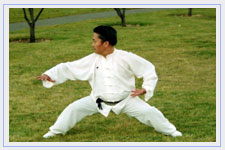 |
Master Xu demonstrates Baguazhang
– “Fu Hu Shi”
|
Palm No. 7 – Hu Zhang (Tiger Palm)
It takes the Zhen sign, symbolizes for thunder, situates at the east, and belongs to the upright group. Externally it represents the anus and internally it coordinates with the spleen. It signifies the tiger, vigour in nature. Its movements mimic a frightening tiger and possess mastering ability.
Palm No.8 - Ma Zhang (Horse Palm)
It takes the Dui sign, symbolizes for lake, situates at the west, and belongs to the upright group. Externally it represents the tip of the tongue and internally it coordinates with the liver. It signifies the horse, wide in nature. Its movement mimics the horse entering the stable and possesses kicking ability.
Xingyi Baguazhang practice emphasizes on the training of Yi (thought), Qi (energy) and power (strength) which can highly harmonize the essence, Qi and spirit of the body in order to achieve a healthy physique and mastering attacking technique at the same time. Practise constantly, one can achieve a broad mind, foster a dynamic and healthy body, therefore many wushu enthusiasts welcome it.
For novice, one needs to draw a circle of approximately the same height of the practitioner. One circle makes approximately eight steps to coincide with the eight positions in bagua. There are three different practising postures i.e. defined posture, life posture and varied posture.
 Top Top |

 Introduction
